

The Problem With Many Farm Fence Installations
Whether you’re fencing livestock, protecting a pasture, or securing acreage, most farm fence projects start with the same question:
“How much does a farm fence cost per foot?”
While price is important, the bigger question should be:
“How long will the fence actually last before it starts leaning, sagging, or needing repairs?”
At CheaperFence, we’ve inspected countless farm fences throughout the Greater Houston area that were only a few years old but already failing due to poor structural design. In most cases, the issue wasn’t the fence wire itself—it was the lack of a proper support system.
Many contractors focus on installing the visible components:
- Fence wire
- Wooden posts
- Gates
Unfortunately, the structural system that keeps everything standing is often minimized or skipped entirely.
Common problems include:
- Leaning corner posts
- Sagging fence lines
- Loose wire tension
- Gate posts pulling inward
- Expensive repairs within a few years
These failures are usually caused by inadequate bracing rather than defective fence materials.
The Difference Between a Basic Fence and an Engineered Fence System
A basic farm fence typically consists of:
- Line posts
- Woven wire fencing
- Gates
While this may appear sufficient initially, it often lacks the structural components needed to resist thousands of pounds of wire tension over time.
An engineered farm fence system includes:
✔ Properly tensioned woven field fence
✔ Pressure-treated round wood posts
✔ Concrete-set posts
✔ Reinforced corner and end assemblies
✔ H-brace systems at critical load points
✔ Proper gate support structures
✔ Long-term tension management
The result is a fence that remains straighter, stronger, and more reliable for years to come.

Why H-Braces Matter
One of the most overlooked components in farm fencing is the H-brace.
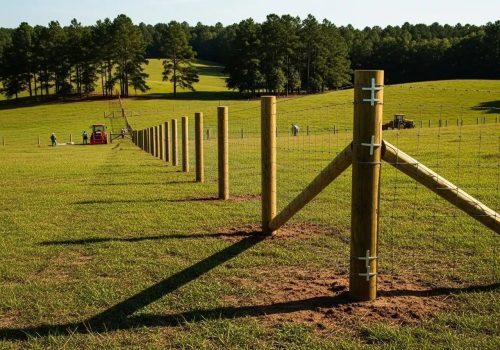
An H-brace typically consists of:
- One corner or end post
- One brace post
- One horizontal brace rail
- Brace wire and tension hardware
Together, these components transfer and resist the tension forces created by the fence wire.
Without H-braces, fence tension eventually pulls corner posts inward, causing the entire fence line to lose alignment.
Typical Locations Where H-Braces Are Required
- Fence start and end points
- Major corners
- Gate openings
- Significant changes in fence direction
Not every direction change requires a full H-brace system, but all critical load-bearing points should be reinforced appropriately.
Why We Recommend 48″ Woven Field Fence for Sheep and Goats
For many livestock applications, we recommend:
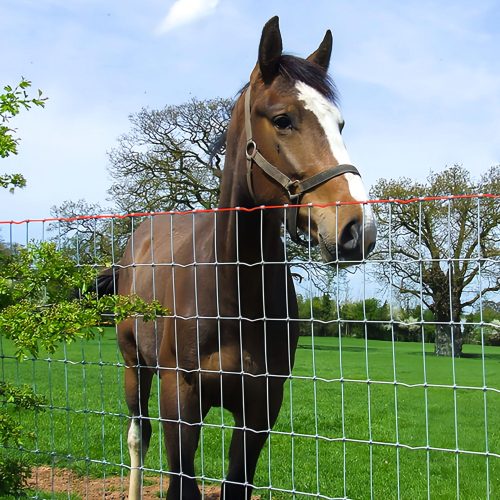
48″ Woven Field Fence (2″ × 4″ Mesh)
Benefits include:
✔ Excellent livestock containment
✔ Prevents sheep and goats from pushing through
✔ More durable than lightweight welded wire
✔ Better long-term performance
✔ Lower maintenance
The woven knot construction allows the fence to flex under pressure rather than break.
Optional Electric Fence Upgrade
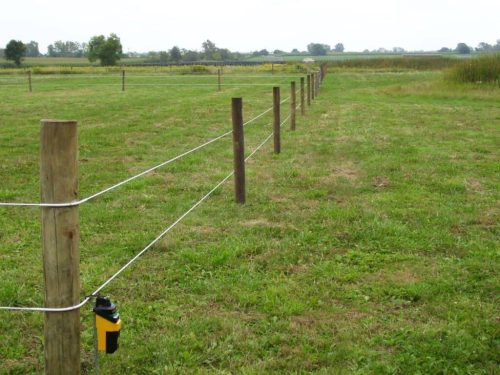
For properties with sheep, goats, or animals that frequently challenge fences, we often recommend adding an electric deterrent system.
This is offered as an optional upgrade rather than a requirement.
Recommended Electric Fence Configuration
Lower Electric Wire
Positioned approximately 10″ above ground.
Purpose:
- Prevents animals from pushing underneath
- Discourages digging and pressure against the fence
Upper Electric Wire
Positioned approximately 36″ above ground.
Purpose:
- Prevents leaning
- Discourages climbing or reaching over
Solar-Powered Fence Charger
The system can operate using a solar-powered low-impedance charger, making it ideal for remote properties where utility power is unavailable.
Grounding System
A properly designed grounding system includes:
- Multiple ground rods
- Ground clamps
- High-quality grounding wire
Many electric fence problems are caused by inadequate grounding rather than the charger itself.

Why We Use Offset Insulators
When electric wires are installed alongside woven field fence, the wires should not contact the fence mesh.
To prevent shorts and improve effectiveness, we install electric wires using offset insulators that position the energized wires several inches away from the fence.
Benefits include:
✔ Better animal control
✔ Reduced power loss
✔ Lower maintenance
✔ Improved fence longevity
Gates Are Often the Weakest Part of a Fence
A gate opening introduces a structural interruption in the fence system.
That’s why we recommend:
- Reinforced gate posts
- Proper gate bracing
- Galvanized livestock gates
- Wire-filled gates when livestock containment is critical
The gate structure should be designed to support repeated use without sagging.
Planning for the Long Term
A farm fence is a significant investment.
When comparing quotes, consider more than just the price per foot.
Ask questions such as:
- Are corner posts reinforced?
- Is a brace system included?
- Are posts set in concrete?
- Is wire tensioned properly?
- Is the gate structure engineered correctly?
- What happens if the fence starts leaning in a few years?
The lowest quote is not always the lowest long-term cost.
Our Approach at CheaperFence
At CheaperFence, we focus on building fence systems designed for long-term performance.
Whether you’re installing:
- Livestock fencing
- Sheep fencing
- Goat fencing
- Perimeter farm fencing
- Electric farm fencing
our goal is to provide a solution that minimizes maintenance and maximizes service life.
Need a Farm Fence Quote?
We install farm fences throughout the Greater Houston area and can usually provide a quote quickly with photos, measurements, or a property address.
CheaperFence.com
📧 info@cheaperfence.com
📞 832-224-5699
They install privacy fences, gates, and full replacements, and can usually provide an instant quote right away if you send photos or measurements.
Related Searches
- Farm fence installation near me
- Woven wire farm fence cost
- Sheep fence installation
- Goat fence contractor
- Electric farm fence system
- Solar powered electric fence
- H-brace farm fence
- Field fence vs welded wire fence
- Farm gate installation
- Livestock fence contractor Houston
- Farm fencing contractor Texas
- 48 inch woven field fence installation
- High tensile farm fence system
- Agricultural fence contractor Houston TX
Discover more from Cheaper Fence
Subscribe to get the latest posts sent to your email.

