

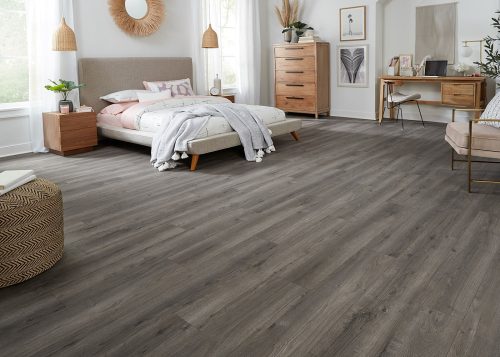
If you’re building or renovating a home but don’t want to blow your budget on the floors, we have one word for you: laminates.
Laminate flooring is a snazzy synthetic, usually designed to look like wood, though it can mimic stone or tile too. Easy to install and maintain, it costs far less than floors made of natural materials.
The average tab to lay down laminate flooring runs between $1,500 and $3,500 or $6 and $14 per sq.ft., including both labor and material costs, according to Adam Graham, an industry analyst at Fixr.com. Genuine hardwood floors cost virtually double that.
However, your exact laminate flooring cost will vary depending on a few factors, including the type you choose and the condition of your existing floors. Here’s what to know before deciding to install laminate floors in your house.
What is laminate flooring?
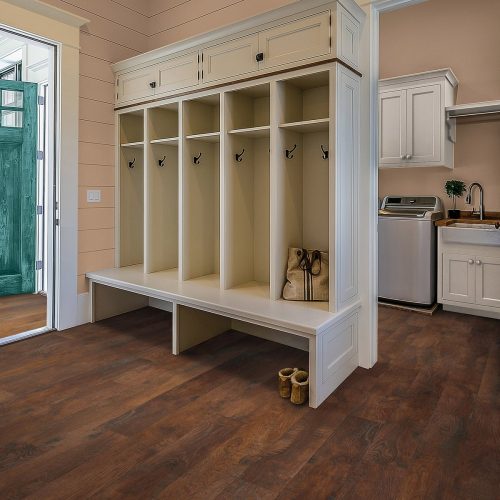
Laminate floors are composed of a series of tiles or planks. Each one is made of several layers that are fused together. There’s a particle board base at the bottom and above it, an image layer: a high-definition printed photograph of wood, tile or whatever material you’d like. On top, there’s a clear layer of plastic, which seals in and protects the layers below it.
Some laminate floors come with their own underlayment, others need a separate one — usually made of cork — installed beneath them, to provide cushioning.
Laminate floors come in different degrees of thickness — between 6 and 12 millimeters (generally, the thicker, the better quality). They can be textured in various ways, from perfectly smooth to high scraped, and finished to look glossy, matte or something in between.
Laminate flooring is a synthetic composite material made from layers of plywood or fiberboard and resin. These layers stick together through a lamination process, hereby giving this flooring type its name. Like engineered wood flooring, the core of laminate flooring is a strong fiberboard or plywood layer. However, unlike engineered wood flooring, which contains authentic wood as the top layer, laminate flooring’s top layer contains imprints that mimic the look of real hardwood floors.
Vinyl and laminate flooring are often confused because both flooring options consist of layers. The main difference is that laminate flooring contains partial wood fibers, whereas vinyl flooring is completely synthetic.
Floor type
Laminate doesn’t just imitate wood, it imitates different varieties of wood. Interestingly, the more expensive natural woods are also the more expensive laminates, because the nuances of their graining and color make them harder to duplicate. If you’re trying to achieve a certain kind of look, you may need to pay more.
According to Fixr.com, the cheapest styles of laminate include acacia, beech and oak, each of which begins at around $1 per square foot (not including installation costs). Elm, maple and hickory are mid-range styles, starting at around $1.50 per square foot. Walnut is the most expensive, starting at $2 per square foot. These “wood” prices in general max out around $4 – $4.50 per square foot.
While wood laminate flooring is the most common (and affordable), there are also other types to consider. The more unusual stone variety, which imitates a repeating pattern of tumbled or antiqued stones, costs a bit more. Tile laminate floors are the most expensive of the bunch.
Your laminate flooring’s thickness can nearly double the price of the materials. Most flooring around 7mm to 8mm thick falls closer to the $1 to $2 range per square foot, while planks that are 10mm to 12mm or more tend to cost closer to the $2.50 to $3 per square foot.
Cost to install by laminate types
| Laminate style | Cost range per sq. ft. (material only) |
|---|---|
| Wood | $1.50-$3 |
| Stone | $3.50-$4 |
| Tile | $3.50-$5 |
Flooring area and shape
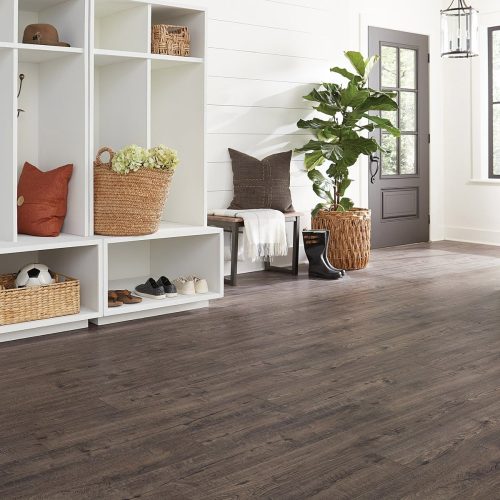
As you might expect, the size and shape of your floors also impact your project cost. In general, the larger your space, the more you’ll pay for flooring and installation. For instance, it would cost an average of $600 to $1,400 to add laminate floors to a 100-square-foot room, $3,000 to $7,000 for a 500-square-foot room, and $6,000 to $14,000 for a 1,000-square-foot room.
Also, if you have a uniquely-shaped room, your installer may need to spend more time custom-fitting the laminate flooring to your space – which can increase your costs for labor and possibly materials as well.
Labor
Flooring installation costs fall between $2 and $7 per square foot. These prices don’t include the cost of the flooring materials. If your pros need to remove the old flooring and discard the debris, anticipate spending more per square foot to install your new flooring.
Additional Costs and Considerations Associated With Installing Laminate Flooring
On top of the typical cost factors, you might incur expenses during the installation. Below are a few examples of additional costs to keep in mind when installing laminate flooring:
Underlayment Installation
A roll of underlayment costs between $40 to $80 per 100 square feet. Before you can install flooring, factor in the cost of underlayment. This padding helps soundproof your flooring, support the planks and provide comfort as you walk across your new floor.
Subfloor Replacement
If you need to repair old subflooring, anticipate spending an additional $300 to $400 per room. Replacing subflooring in too poor of a condition costs around $600 to $700 per room on average.
Old Flooring Removal
On average, you’ll spend an additional $0.50 to $3.50 per square foot to hire a pro to remove the old flooring. Costs to remove flooring depend on the type of flooring you want to replace. For example, to remove tile, you could spend between $2 and $6 per square foot to, but this higher price range is the exception rather than the norm.
Disposal of Old Flooring
Junk removal costs fall around $225 on average. You can save on these costs by disposing of old flooring yourself using a truck.
Upgrades
Laminate flooring may have upgraded options that can increase the price by $1 to $3 per square foot on average. Several add-ons include water resistance, scratch resistance and noise resistance features. Though these features increase the cost of your flooring, they might increase the material’s lifespan, making it worth it overall.
Benefits of Laminate Flooring
If you’re undecided whether it’s worth your while to install laminate flooring, it might be a matter of seeing all the benefits that helps you seal the deal. Pros of choosing laminate flooring include:
- Cost-friendly
- Durable
- Versatile styles and appearances
- Easy maintenance
- Easy to install
- UV-resistant
- High-traffic tolerant
- Scratch-resistant
- Fade-resistant

DIY Laminate Flooring Installation vs. Hiring a Professional
You could save a pretty penny if you decide to install laminate flooring yourself. However, if you’ve never installed flooring before, attempting to DIY it could cost you in materials or premature replacement of your flooring.
Hiring a professional flooring company adds $2 to $7 per square foot to the installation, which can amount to an additional $300 to $1,100 for an average-sized room, depending on the complexity. At the same time, properly installed flooring helps preserve the lifespan of your flooring so that you can enjoy it for years to come.
How to Save Money on Laminate Floor Installation
Installing new flooring can quickly add up. Fortunately, you might be able to save on the total cost of your project with some of the following tricks.
- Install laminate flooring only where you really want it, avoiding moist areas of your home, to save on materials
- Move furniture out of the room yourself
- DIY what you can. You might want to take a hand at removing old flooring, for example.
- Get rid of debris on your own.
- Compare floor installation companies to find the most competitive price in your area
- Renovate your flooring during the off-peak season
- Buy an in-stock material rather than a custom or obscure material
- Choose a wood-styled laminate flooring over one that mimics tile
- Weigh the cost of any upgrades like scratch resistance or water resistance
To arrive at the average costs in this article, editorial team members surveyed 9 providers and 6 cost databases on national and local levels. All averaged figures were correct at the time of publication and may be subject to change.
Discover more from Cheaper Fence
Subscribe to get the latest posts sent to your email.

